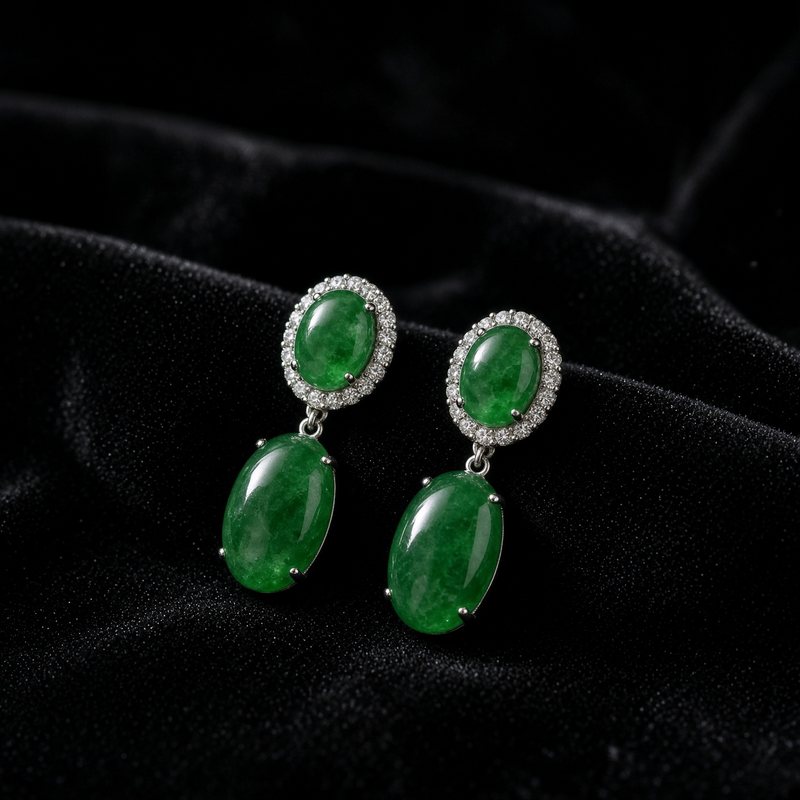
Jadeite
Jadeite is a pyroxene, a sodium aluminium silicate, not the amphibole structure of nephrite. Glass-type, icy and glutinous describe grain and transparency, not a marketing pyramid. Glass-type should be transparent enough to show its cotton and veins and still keep nerve. Icy is semi-transparent. A surface glow is either there or it is not. Do not invent it with a lamp.
A-jade means the stone was not acid-stripped and refilled with polymer. B-jade leaves an organic signature in the infrared, roughly between 2800 and 3200 cm−1. That is a laboratory sentence. C-jade is dyed. Dye can be beautiful and must be named. Yunxiu aims only at A-jade. The line reads: no polymer impregnation, subject to testing.
Beyond transparency there is the ground of the colour. A grey-green stays dull however clear it is. Colour that floats on the surface breaks when the structure moves. We would rather keep a slightly quieter stone with a clear structure than a loud colour that has been helped. Jade’s luxury is nerve, not shout.
Measure in millimetres. Thickness decides whether light can pause inside a cabochon. Too thin, and it is clear and also empty. Yunxiu would rather be thick than flat. Gold follows the rim. It does not turn the jade into a badge.
Before the instrument, the eye still has work. A strong light asks whether the structure is continuous, whether the colour sits inside, whether the surface looks etched and porous. This does not replace the infrared. It decides whether the piece deserves the test. Most of Yunxiu’s time is spent there. Testing confirms. It does not discover.