Tanying
Tanying
A neon glance, like the eye of a deep pool.
The neon of Tanying is copper in tourmaline. True Paraíba is rare. Copper-bearing blues from Brazil, Mozambique and Nigeria can look alike; the name and the origin should not be collapsed. We write copper-bearing tourmaline unless a certificate supports the Paraíba designation.
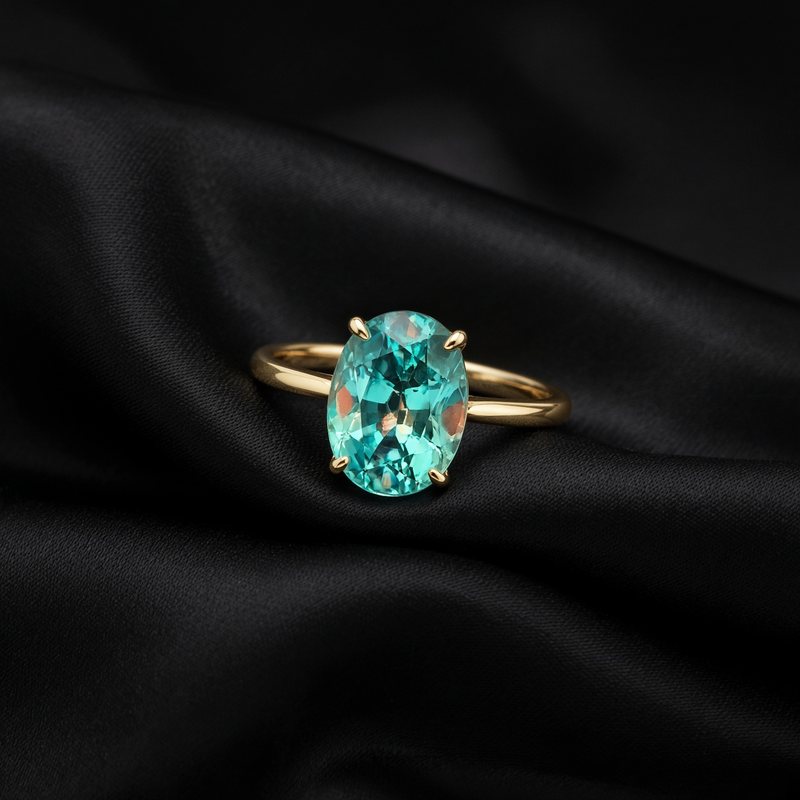
The stone will not bear a heavy base. Few prongs. The light comes off the pool directly. The collection stays small because the material does.
Copper-bearing tourmaline only. Paraíba is used when a certificate supports it. Few prongs.
Light
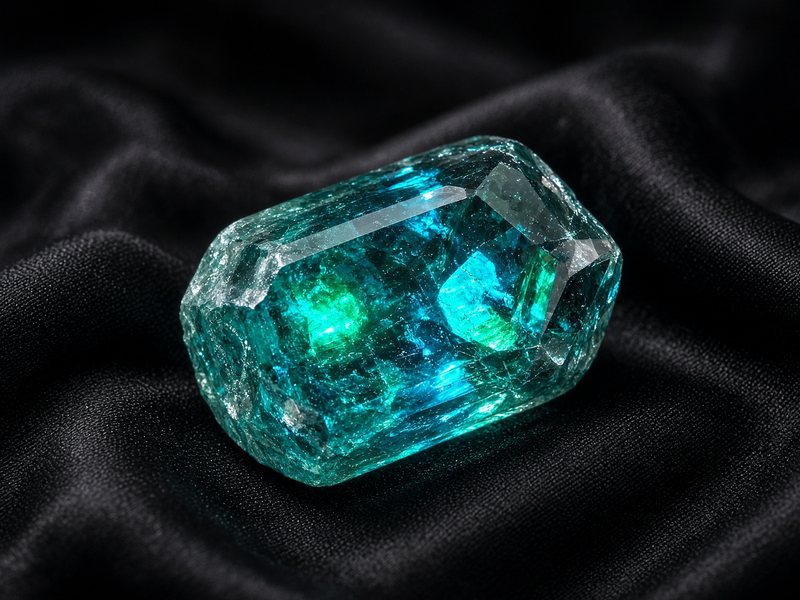
Tanying is a copper-bearing tourmaline, not black jade and not a blue-water jadeite. The neon comes from copper, from inside the crystal. If the dark has no direction and the edge looks lacquered, that is a picture, not the stone. Turn it ten degrees and the colour should move.
The weight of the name Paraíba is a short Brazilian mining history. Mozambique and Nigeria can be just as bright. Laboratories do not agree on whether every copper-bearing blue-green may carry that place-name. The title on this page therefore stops at copper-bearing tourmaline. A place appears only when a certificate writes it, and it does not replace the material.
The brightness is loud, so the ground must be black. After black silk has eaten the room, the neon is worth keeping only if it is still there. A blue that dies when the lamp dies was made by contrast. Tanying is not compared with diamond return or with jade diffusion. It is compared with whether the crystal still has an internal grain.
Tanying is not ink-green jade. Jade’s black-in-reflection and green-in-transmission do not belong here. Its double is the angle: bright toward you, withdrawn a moment later. Under the loupe the grain should still be there.
Making
Use few prongs. Four is already many. Stability that comes from a thick wall puts the neon out. The seat is only high enough for light to enter the table and leave at the side. A closed cup dulls it. This is not an invisible setting. Tourmaline is not asked to be ground into a hidden rail.
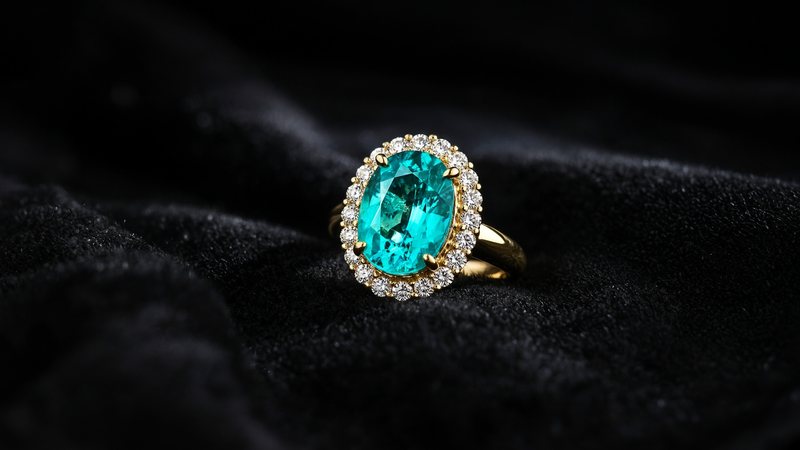
The gold is warm and only a pin. Take the gold away and the colour should still be a whole stone. If the gold is seen first, the design has failed. Micro-pavé is an exception, and the exception must be too small to become a second light.
Some planes of the metal rest. Fully bright gold beside neon stings, and the eye starts to read a sign. A narrow matte edge near the seat gives the brightness somewhere to stop. Weights and gaps belong to the object, not to a decimal on a page.
The hoop is not hair-thin. A small shoulder between hoop and head takes a sideways blow. A pendant rests slightly upward, not as a vertical sign.
Keeping
The market moves because names get promoted. Copper today is Paraíba in the retelling, and a place-name in the catalogue the day after. What should be kept is the certificate’s original sentence, including the part it refused. A refusal is often more useful than a more expensive word.
It fears a blow, and it fears heat during a remount. Do not pass on only the word bright. Pass on the material, the colour that jumps, the open base, and which report would not lock a place-name. Brightness dates. The sentence dates less. Few pieces means little material, not a manufactured hunger.
Letters, appraisals and insurance use the certificate’s material name. If someone says Paraíba aloud, the sentence is put back. It is a poor everyday ring unless the risk is written down.
Drag to turn. The wireframe shows the structure of this material. It is not a scan and not a certificate.
| 主石 | Copper-bearing tourmaline |
|---|---|
| 顏色 | Neon blue-green, moving with the angle |
| 名稱 | Paraíba only when a certificate names that origin |
| 鑲嵌 | Few prongs, the seat left open |
| 金屬 | 18k gold |