Moyun
Moyun
An aurora inside an ink wash.
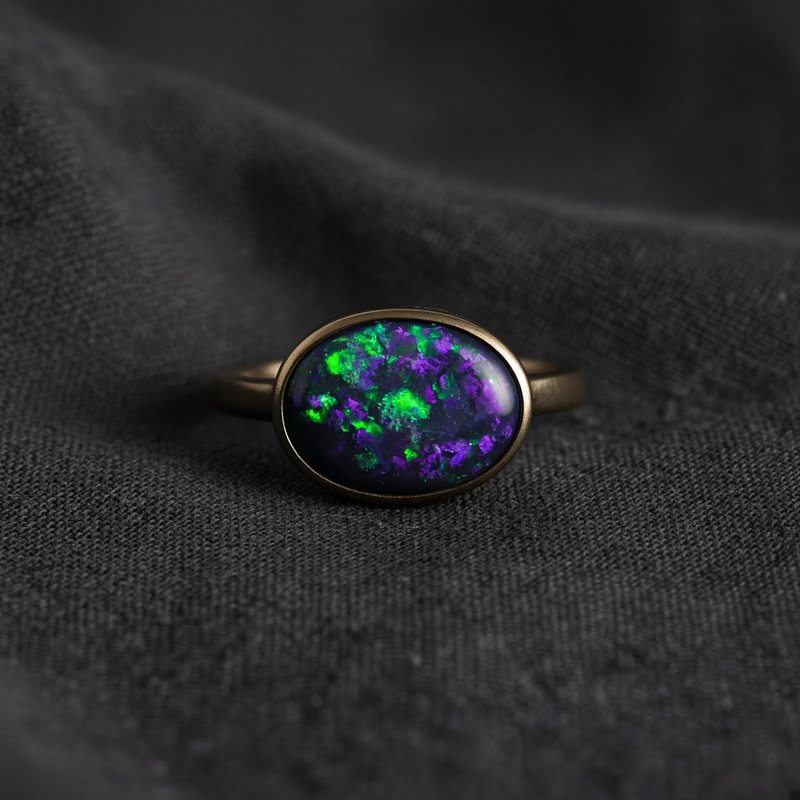
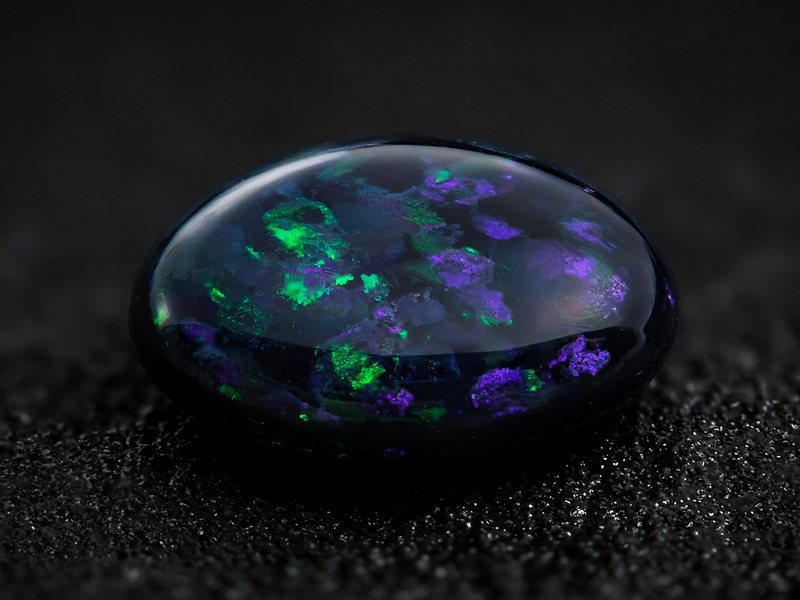
Moyun sets the play-of-colour of black opal into an almost black ground. We do not want a rainbow on demand. Green and deep violet should arrive at an angle. That directionality is the stone’s honesty. If the body tone is grey, colour looks applied.
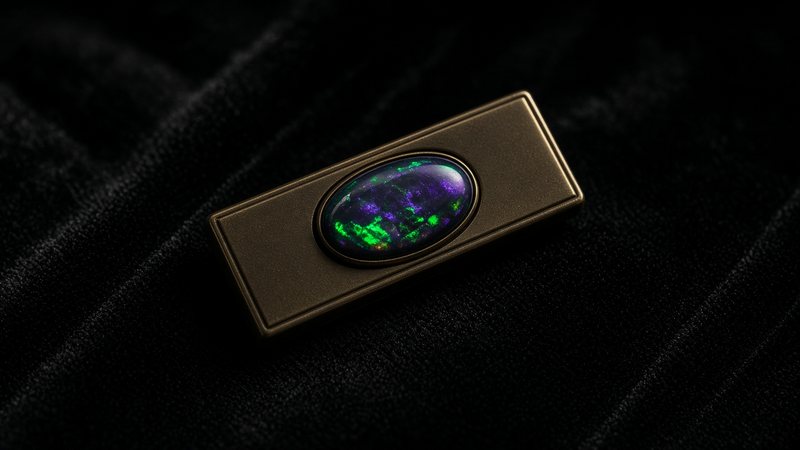
Dark metal is only the frame, the border of a page of calligraphy. The collection does not compete with diamond. It asks whether light still exists in the dark.
Black opal, directional play-of-colour, dark body. No other gem stands in for it. Do not expect every angle at once.
Light
Moyun is black opal, not a diamond in a dark field and not black chalcedony. The colour is diffraction from spheres of silica. Turn the stone and the colour changes. What is wanted is not a rainbow open in every direction at once, but green and deep violet that consent to appear at an angle. Direction is the honesty of opal. The body must be dark. A grey body makes the colour look applied.
Body and play-of-colour are read apart. The body is the tone. The play is what the structure does to light. If the body is not dark, even a busy play will not stand. That is why the series is nearly black. Black is not there for mystery. Mystery is a cheap adjective. Black gives the green a ground that does not dilute it.
A turning film is not a substitute for the eye. A film can stop at the best angle and pretend the colour is constant. Constant is not opal’s language. In the salon the stone is turned slowly. The moment the colour leaves matters as much as the moment it arrives. Leaving shows it was not locked in by a coating.
A green that is slightly yellow, a violet slightly grey, can still be true. Filter-pure colour is a reason to rephotograph, so the opal is not made to look like a copper tourmaline. A brown body under transmitted light does not by itself dismiss the stone.
Making
Opal is brittle. It fears heat, shock and dryness. The default is a bezel or a low frame, not a tall prong. A tall prong holds a fragile dome where it will be hit. The frame is a border: thin enough not to steal the colour, thick enough not to bend. Dark gold is only that border.
The surface is not grooved for an invisible setting. The colour layer is often thin. A little ground away and the colour breaks. A bead, if any, sits on the body at the edge, not in the colour. One opal is the whole piece. A diamond halo would turn the play-of-colour into noise.
Polish is strict with the metal and gentle with the stone. The dome wants a continuous skin, not a diamond’s edges. Too much shine makes the dome look like plastic. A narrow bright line may live on the outer metal. The inner edge, against the stone, stays matte and gives the eye back to the colour. Measure in millimetres.
The joint of the frame sits on the hidden side and can be opened later. A frame welded shut is rude to a fragile material. The chain is not soldered to the back of the dome. Heat stops at the frame.
Keeping
Origin and whether the stone drinks water are separate questions. Some opal takes up water and the colour moves. If neither the report nor the seller has said whether this one is hydrophobic, what the body is, and whether it was treated, it cannot be finished off with the six words Australian black opal. This page does not sign every piece to the same mine.
Care is stricter than for diamond. Extreme dryness, perfume and ultrasonic cleaning are refused. A crack, once begun, is not a story polish can save. What is passed on is the angle that gives green, the angle that gives violet, and the angle that gives nothing. Nothing is character, not a defect to be cut away or lit forever from the best degree.
It should not live in a cabinet dried to the point of baking, nor in a box sealed to an extreme. The next keeper should know the angle of green, of violet, and of nothing. A lamp may help the eye. It may not rewrite the character.
Drag to turn. The wireframe shows the structure of this material. It is not a scan and not a certificate.
| 主石 | Black opal cabochon |
|---|---|
| 變彩 | Directional, not promised at every angle |
| 底色 | Dark; the tone is read on the object |
| 鑲嵌 | A thin bezel, no invisible groove |
| 尺寸 | Millimetres |